Dual Sources Photoemission Spectroscopy
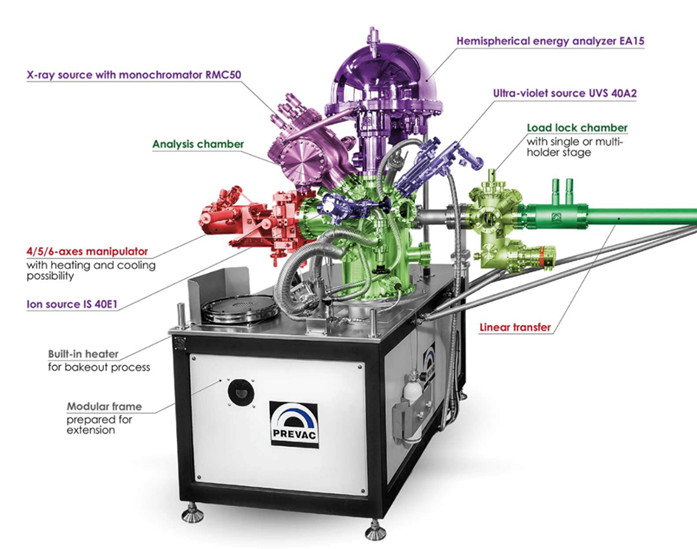
Photoelectron Spectroscopy is a surface chemical analysis technique that can be used to analyze the electronic structure and chemical composition of a material's surface. The principle is based on the photoelectric effect, where when light is irradiated into the sample, electrons of the atoms will be excited to produce photoelectrons. Only the photoelectrons near the surface of the material can escape and be detected by the instrument. By analyzing these photoelectrons, the type of surface elements and their composition can be determined. This equipment is equipped with two light sources, X-ray and ultraviolet light.
Equipment Description
- Model:Prevac, XPS/UPS system
- Specification:
- Energy Analyzer
Used to measure the kinetic energy of photoelectrons
The operating pressure of the Energy Analyzer can be expanded from UHV to 1 mbar
Capable of measuring XPS/UPS/AES functions under ultra-high vacuum:
Energy analyzer radius:≥ 150 mm
Pass Energy:at least 1, 2, 5, 10, 20, 50, 100, 200 eV
Kinetic energy measurement range:0 - 2000 eV, accepts over 2000 eV
Energy Resolution:< 5 meV FWHM
Detector type:MCP-CCD
With monophotometer X-ray, under the condition of ultra-high vacuum, Ag 3d is measured, and its full width at half maximum (FWHM) energy resolution is ≤ 0.47 eV
With a vacuum ultraviolet light source (He I), under ultra-high vacuum conditions, Ag is measured, and its Fermi Level (Fermi Level) energy resolution is ≤ 170 meV
- Monochromated X-ray: the anode types are Al-Kα (1486.6eV) and Ag-Lα (2984.3eV)
- Vacuum UV light source specifications: Ag is measured using He I with a Fermi level energy resolution ≤ 170 meV
Service items
- XPS surface component qualitative and quantitative analysis, chemical shift analysis
- UPS Valence Band Analysis
Preparation of specimens
- Samples must not be liquid, powdery, toxic, magnetic, radioactive or would cause damage to vacuum chamber parts.
- Samples should be low non-volatility to avoid pollution to the ultra-high vacuum system. If there are highly volatile molecules or coatings, please be sure to exhaust them by yourself in advance.
- X-ray spot is 1mm * 4mm, so the sample area must be larger than the square of 5mm * 5mm, but no more than the maximum square of 20mm * 20mm, and its thickness should be less than 5mm.
- In order to prevent difficulties in the test, or the same material should be in two states of unclear surface and clear surface, it is recommended to prepare two samples for the testing service.
- If the sample has poor conductivity and you do not want to use C signal correction, it is recommended to plate a thin layer of gold on the surface of the sample. Or use a mask to plate a thin layer of gold around the sample for its signal correction to be easier.
- The sample surface needs to be flat enough to have good signal quality.
- Samples must be sent back for delegated measurement. Please prepare and fill in the self-addressed envelope and affix corresponding stamps to send it back.
- During the analysis test, if the sent sample is found to be incompatible with the regulations, it will be returned and the payment will be made according to the working hours.
- Whether it’s necessary to add the electron gun depends on the conductivity of the sample and the substrate. If the sample or the substrate is an insulator, the electron gun needs to be added, otherwise the signal cannot be measured.
Charge
- Project:Monochromated XPS $350/hr; UPS $400/hr, additional $50/hr for electron gun, $100/hr for Ar ion gun (surface cleaning, depth analysis)
(1) Both XPS and UPS are charged according to the time period, counted with actual service hours (including sample processing time, sample vacuuming time, shutdown waiting and data processing time, a total of about 3 hours)
(2) The charge of express mail is $4,500/hr
(3) Late time is still considered as service time for charging
(4) If the electron gun and Ar ion gun are used for less than 1 hour, it will be calculated as 1 hour
- Non-Project:Monochromated XPS $3500/hr; UPS $4000/hr, additional $500/hr for electron gun, $1000/hr for Ar ion gun (surface cleaning, depth analysis)
Returning Time
Depends on the number of samples to be tested and the appointment time, about 2 weeks to 1 month.
Measurement Request Form
After completing the appointment on NTSC, please fill out this form or the service will not be provided.
https://docs.google.com/forms/d/1onjE7pUKzfmXCbhxib92VVjqGyCoAgHB9noIiMch5j8/edit
Contact Detail